What I believe
I count what nobody counts. Here are the provocations I'd put to your board, the forecasts behind them, and what would prove me wrong.
Most talks about the future offer doom or hype. Here’s what I do instead (30 seconds).
Everyone's investing in the pillars. I look at what they're standing on.
Volatility is now like gravity getting stronger. Everything still stands, until you find out which foundations were never built for the extra weight.
Money is pouring into the resilience economy: new infrastructure, secure supply chains, insurance, health systems, early-warning technology. Those are the pillars. But every pillar stands on things no balance sheet counts. Nobody pays for them until they break, and when one gives way, everything above it wobbles at once.
Most plans are still tested against one shock at a time. The real world doesn't send them one at a time: a heatwave during a cyber attack, a flood while the schools are shut, a port closure the week your insurer walks away. The foundations that hold against one shock give way when three arrive together.
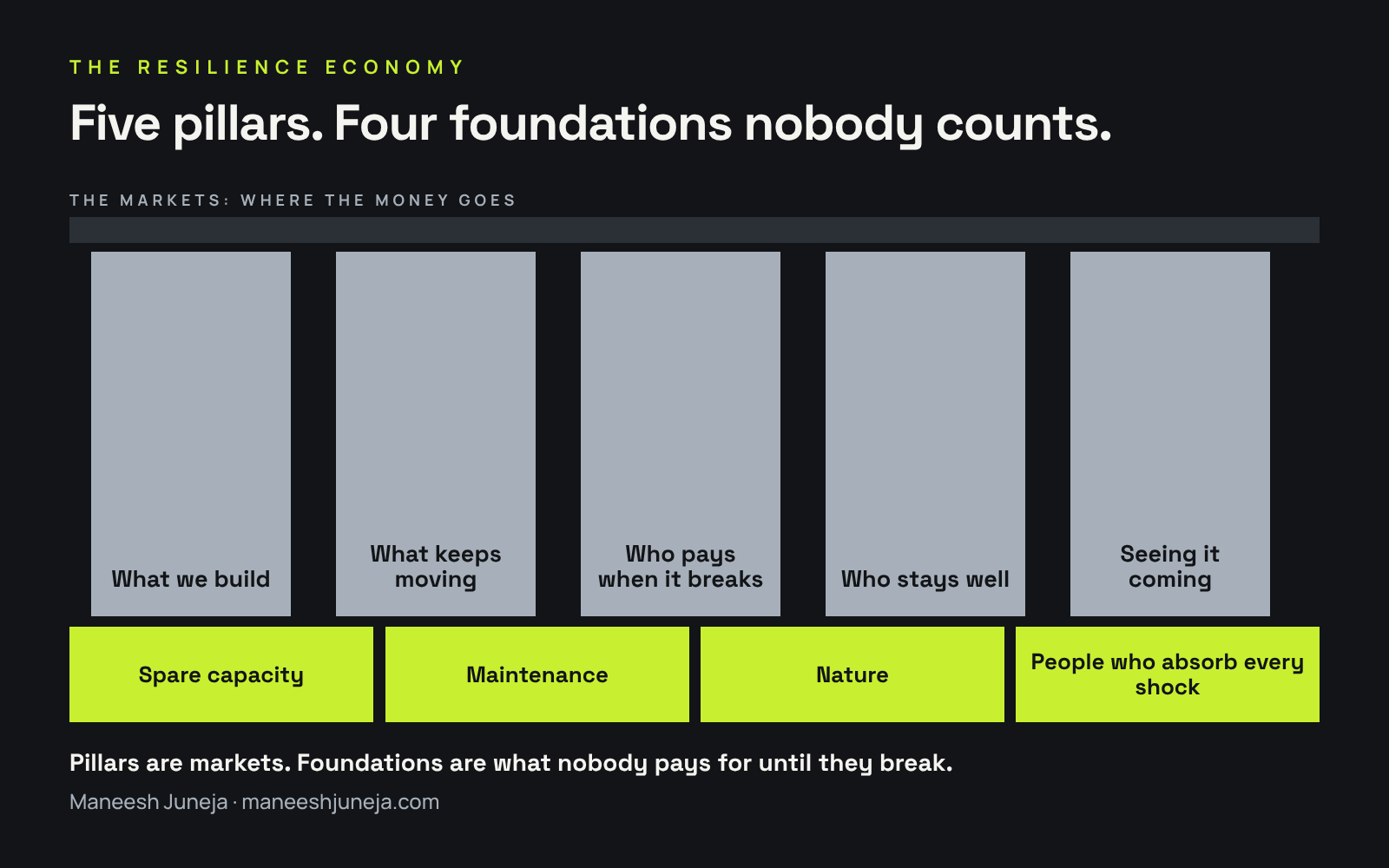
The five pillars of the resilience economy
These are the markets: where the money goes and where the opportunity is.
1. What we build. Buildings, bridges, ports, grid lines and data centres. Stands most visibly on maintenance.
2. What keeps moving. Food, water, energy and goods, from medicines and critical minerals to software, cloud and payments. Stands most visibly on spare capacity.
3. Who pays when it breaks. Insurance, credit and the cost of capital. Stands most visibly on nature.
4. Who stays well. People's health through heatwaves and shocks, and the systems that care for them. Stands most visibly on people.
5. Seeing it coming. Early warning, data and AI. Stands most visibly on people: the ones who keep things running when the systems go dark.
Defence and national security run across the first, second and fifth pillars. They're a buyer of resilience, not a separate market.
The foundations nobody counts
Underneath all five pillars are four things that can be measured but almost never are:
- Spare capacity. The stock, slack and backup cut to save money in calm years.
- Maintenance. The upkeep deferred until it becomes a failure.
- Nature. The wetlands, soils and catchments that quietly absorb floods and protect water supply.
- The people who absorb every shock. The staff, carers and families who hold things together when formal systems stop.
Pillars are markets. Foundations are what nobody pays for until they break.
I'm not the first to say some of this. Marilyn Waring showed decades ago what GDP leaves out. I look at the next layer: what your balance sheet leaves out, and the market hiding in it.
Ten provocations, and the forecasts behind them
Audiences don't need another tour of trends. They need someone to say what they actually think. So here it is: a provocation and the forecast behind it. Each forecast says what would prove me wrong, so you can hold me to it.
Every efficiency drive should publish what it sold off: the spare bed, the spare person, the spare day.
What I believe: by 2030, resilience will be judged in the boardroom the way cyber security is today: a standing duty of leadership, not a project. The organisations still building for a world that no longer exists will be the ones caught out.
Evidence: Munich Re says floods, thunderstorms and wildfires caused about $98bn of the $108bn in insured natural-disaster losses in 2025. The shocks have changed shape.
Wrong if: by 2030, most large boards still treat resilience as a one-off project, with no standing owner and no regular testing.
▶ Watch the preview video: The End of Normal →
Your pension fund already owns the flood risk. It might as well own the wetland that stops it.
What I believe: physical climate risk is still mostly outside the price. I expect a visible repricing to start in insurance and property in the most exposed regions well before 2030. Not as one big market event, but region by region.
Evidence: State Farm stopped writing new home policies in California in 2023, then said it wouldn't renew about 72,000 property policies.
Wrong if: by 2030, homes in the highest-risk areas still sell and get mortgages with no measurable discount against similar low-risk homes.
▶ Watch the preview video: Priced for Calm →
In a heatwave, some of the biggest risk in the house sits in the bathroom cabinet.
Heat risk depends on the medicine, the person and the conditions. Nobody should stop or change their medicines without advice.
What I believe: by 2030, leading health systems and insurers will run heat-season outreach to the people most at risk as routinely as they run flu-season campaigns.
Evidence: one US insurer, CVS Health/Aetna, already phones more than 9,000 Medicare patients before extreme heat and reviews their medicines. Most health systems still don't.
Wrong if: insurers that pilot heat outreach can't show fewer heat-related admissions within two or three summers.
Read about the keynote: Side Effects of a Hotter World →
A data centre's planning permission should name the neighbours it keeps warm.
What I believe: by 2030, power, water and grid connections, not chips, will be the main limit on where AI gets built. And they'll be a standard question in every AI investment decision.
Evidence: data centres used 23% of Ireland's metered electricity in 2025, up from 5% in 2015. The UK's Data Centre Covenant (October 2026) now asks developers to reuse heat for nearby homes, schools and hospitals.
Wrong if: by 2028, waits for grid connections in most of the main data-centre hubs (Dublin, Amsterdam, Johor, Northern Virginia) are getting shorter, not longer.
▶ Watch the preview video: Everyone Counted the Chips →
The first flood defence to fail may be the drain nobody has cleared.
What I believe: the biggest items in the 2075 accounts are the ones we don't count today: nature, maintenance and care. I expect long-horizon funds to start reporting at least one of them before 2035.
Evidence: Norway's sovereign fund already defines its purpose as wealth for "current and future generations". The future is in the mission statement. It just isn't in the accounts.
Wrong if: by 2035, no major pension or sovereign fund reports on its exposure to nature, maintenance or care.
▶ Watch the preview video: The 2075 Balance Sheet →
Grandparents are critical national infrastructure. So why are they missing from every continuity plan?
What I believe: by 2030, caring will be the biggest unmanaged reason good people leave.
Evidence: in Japan, 106,000 people left their jobs in one year (to September 2022) to care for family.
Wrong if: exit surveys that record both reasons still show childcare clearly ahead of caring for ageing family.
▶ Watch the preview video: The Shock Absorbers on Your Payroll →
A missile can stop an army. It can't feed a country.
What I believe: security budgets should buy civil resilience: food, water and power for ordinary communities.
Evidence: NATO allies agreed in 2025 that up to 1.5% of GDP a year can go to civil preparedness and critical infrastructure. Finland is moving from six to about nine months of grain reserves.
Wrong if: by 2028, most of the 1.5% is going on relabelled roads, grids and existing programmes rather than new capability.
▶ Watch the preview video: When Essential Systems Fail →
Flood Re ends in 2039. A 25-year mortgage signed today outlives it by 12 years. Who told the buyer?
What I believe: insurance, not sea level, will redraw the property map first. Where insurance goes, mortgages follow. Where mortgages go, people follow.
Evidence: the summer before the Los Angeles fires, State Farm dropped about 1,600 home policies in Pacific Palisades. Flood Re, which keeps UK flood insurance affordable for eligible homes, is due to end in 2039, and the Climate Change Committee wants a decision on its future.
Wrong if: Florida's turnaround spreads. Citizens fell from 1.4 million policies in 2023 to about 300,000 in 2026 as private insurers returned. If cover stays available and affordable in high-risk markets without large public subsidy, insurance isn't the trigger I think it is.
▶ Watch the preview video: Where Will Everyone Live? →
Two more I can't stop thinking about
The Gulf's next export isn't oil. It's knowing how to live at 45°C, and southern Europe will be buying.
Wrong if: the Gulf keeps solving heat with cheap energy and never sells what it knows about living with it.
A city can install a million air conditioners and still run out of people to fix them.
Wrong if: cities that saw cooling demand surge also kept repair waits short through their worst heatwaves.
Disagree with me?
Good. The best conversations I have start there. If one of these lands, or you think I've got one badly wrong, let's talk.