Most Leaders Are Still Building For A World That No Longer Exists

The $4.4 trillion gap that will separate tomorrow's winners from everyone else

Your boardroom is making decisions based on assumptions that were no longer true five years ago. Coastal cities are sinking. Floods and fires are redrawing distribution routes. The infrastructure built for a stable planet is cracking under the heat it was never engineered to withstand.

Here's what few in the sustainability conversation want to say out loud: even if every country takes significant action to drastically reduce emissions, we're still facing a couple of decades of disruption. The volatility we're seeing now with our planet. This is as calm as it gets.

Yes, reducing emissions is critical to slowing down the rate of global warming. However, the real question, the one that will determine which organisations dominate the next two decades, is this: who is building systems that can generate value on a planet that has fundamentally changed?

When I first pivoted from looking at the future of digital health to the future of planetary health just over two years ago, I wasn't thinking about opportunity. I was drowning in guilt. The data on extraction, pollution, and emissions since the Industrial Revolution made me feel ashamed for merely existing, for buying imported fruit, heating my home, flying to visit family. Everything I did seemed to be making things worse. All of our human activities contribute to emissions that continue to heat the planet; even hospitals performing life-saving surgeries, clinical trials testing the newest cancer treatments, and nursing homes caring for the oldest members of our society. It took me months to realise that this paralysing shame was itself part of the problem, and that there was another way to look at what's coming.

Immersing myself in planetary health revealed something else: how deeply interconnected our systems are, food, water, energy, health, and finance, mirroring nature's interconnected systems, and how many still view the environment through the narrow lens of climate change. Earth’s systems are being affected by how we live, work, and play, as I came to understand when I worked in digital health; health extends well beyond healthcare itself, and our health is shaped by every government policy, from transport to energy to agriculture. The same applies to our heating planet; it extends well beyond the Ministry of the Environment at the government level or the Sustainability team in a corporation. Our future depends on leaders who can step back and see these connections.

The Trillion-Dollar Opportunity Nobody's Talking About

In September 2025, the Planetary Health Check confirmed what many of us had feared: humanity has now crossed seven of the nine planetary boundaries that keep Earth stable and habitable. Climate change, biosphere integrity, land system change, freshwater use, biogeochemical flows, novel entities (e.g., microplastics), and now, ocean acidification. Only ozone depletion and aerosol loading remain in the safe zone. All seven breached boundaries are worsening.

This isn't about doom. It's about reality. We are already living on a different planet than the one our systems were designed for, and that gap between design and reality is widening every year. This understanding led me to what I call the Resilience Economy, or what investors like BCG are calling 'the next trillion-dollar investment opportunity' in Climate Adaptation & Resilience.

The Resilience Economy encompasses every sector that must redesign for a volatile planet: infrastructure engineered for extreme weather, supply chains built to flex rather than break, agricultural systems that thrive in unpredictable conditions, energy grids that function when the old assumptions fail, insurance products that price for actual risk, and technologies that help communities anticipate what's coming.

The numbers are staggering. McKinsey estimates climate resilience technologies could represent markets worth $600 billion to $1 trillion by 2030.
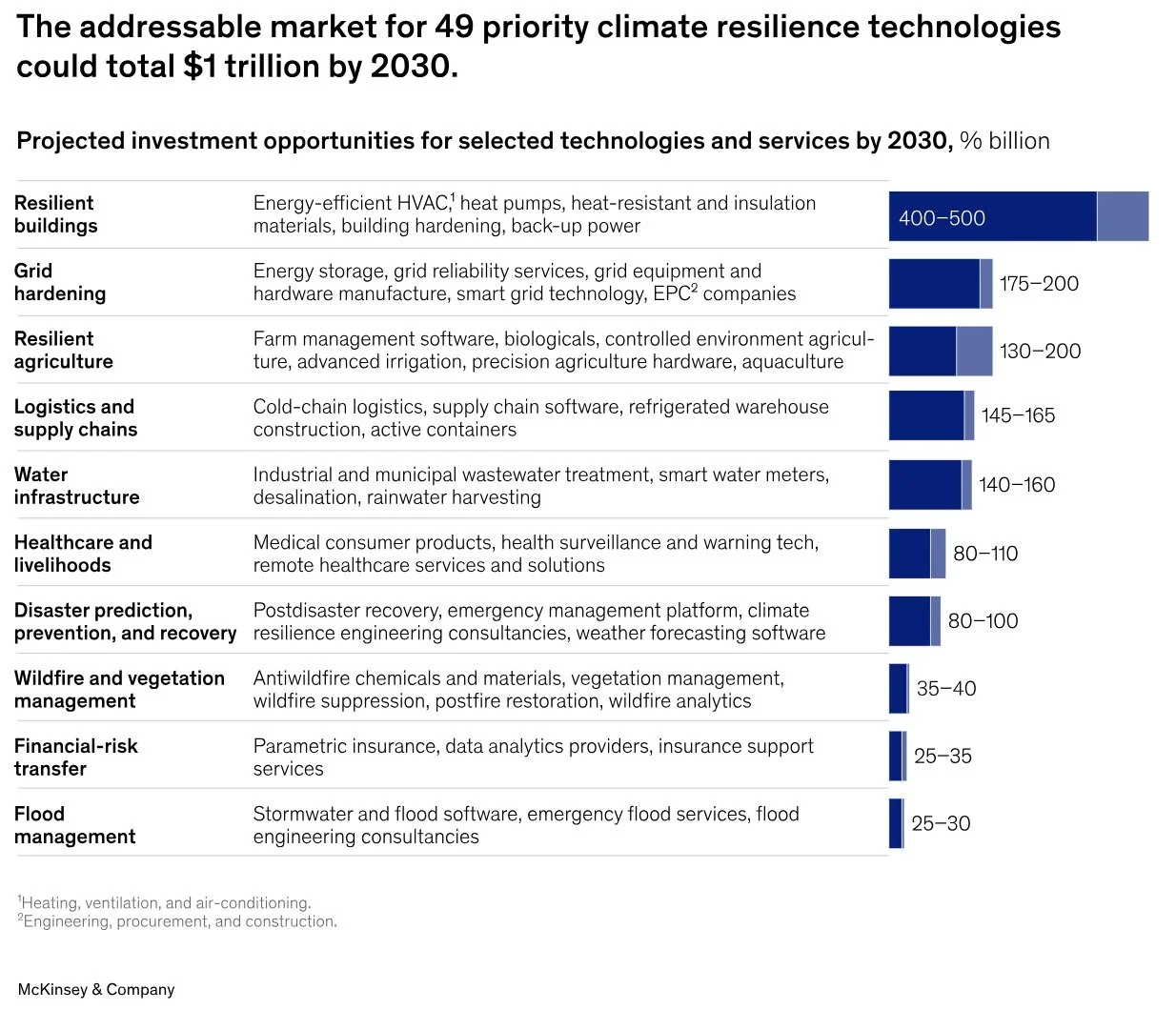
Climate resilience technology: An inflection point for new investment - McKinsey - September 2025

BCG and Temasek project global adaptation spending hitting $1.3 trillion annually by the same year. GIC calculates that adaptation investment opportunities will grow from $2 trillion today to $9 trillion by 2050. The World Bank calculates that investing in resilient infrastructure delivers $4 in benefits for every $1 invested. Yet UNEP's 2025 Adaptation Gap Report paints a starker picture: developing countries need $310- $ 365 billion annually for adaptation but received only $26 billion in 2023—a gap that disproportionately affects the Global South.

Yet new research from S&P Global reveals that only 35% of companies have any kind of climate adaptation plan, even though climate change could cost major global companies $1.2 trillion annually by the 2050s.
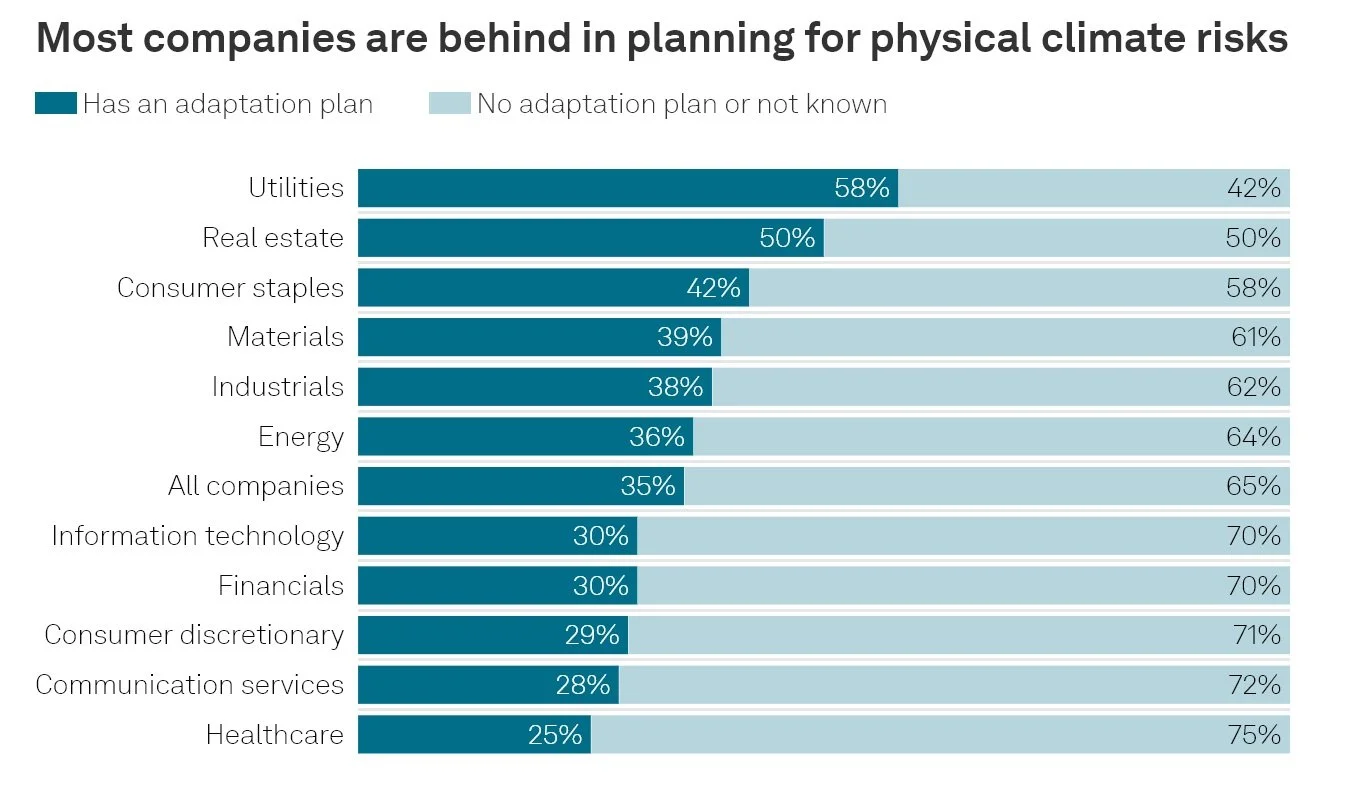
Climate costs are rising but few companies have an adaption plan - S&P Global - March 2025

Healthcare sits at just 25%. IT and financial services: 30%. When 65% of your competitors are flying blind into disruption, the companies that move first don't just survive, they capture market share that never comes back.

The Climate Policy Initiative estimates that global climate finance reached $1.9 trillion in 2023, but we need $6.3 trillion annually by 2030. That $4.4 trillion annual gap isn't a crisis. It's the most significant commercial opportunity any of us will see in our careers.

The Stakeholders Missing from The Room

There's something peculiar about the planetary health conversation that took me months to notice. The genuinely excellent events I’ve attended, which explore topics including food systems, water security, and climate adaptation, feature leading scientists, researchers, and NGOs. Still, three stakeholder groups are almost absent: corporations, investors, and entrepreneurs. These are the very people who play a significant role in shaping future systems.

I’ve discovered so many insights from listening to the planetary health community. When I've tried to share these with businesses, hospitals, banks, defence firms, and more, the response is almost always the same: 'Maneesh, so what? What's the bottom line for us, right here and right now?' At a recent dinner party, I was chatting with another guest about my work. When I mentioned that we need to move toward a regenerative, nature-based economy, they looked at me as if I were speaking a foreign language. Their response? 'OK, that sounds impressive, but what does it mean for me and my firm? What products could I sell in this new economy?' It really hit me that what people desire is clarity: which new markets, where the customers are, and how to solve a meaningful problem and generate value.

It became clear that sharing more reports and scientific papers wasn't going to work. The real message needs to be simpler: if human activities continue to accelerate changes to the planet's natural systems, every organisation, large or small, will be affected, including their ability to grow profits, sales, and market share. That's the bottom line.

Here's the opportunity: governments alone cannot fill a $4.4 trillion annual funding gap. The scale of capital required to build resilient systems exceeds what public finance can deliver. Private investment isn't optional, it's the difference between solutions that remain in pilot phases and solutions that reach the billions of people who need them. This is where I come in: as a bridge between worlds that don't naturally speak to each other, translating scientific urgency into business opportunity, helping business leaders view their strategies through the lens of planetary health.

Why The Transition Won't Be Linear

That guilt I described. It wasn't an accident. I later discovered that the concept of the 'personal carbon footprint' was popularised by a BP advertising campaign in 2004, designed to shift responsibility from corporations onto individuals. Tobacco companies and plastics producers use the same playbook. Suddenly, I understood why so many people in this space walk around carrying a low-level shame simply for being alive, and why that guilt is paralysing rather than motivating.

I'm not arguing against changing individual behaviour. But there's been an excessive focus on personal carbon footprints that distracts from the more complex work of transforming the systems we all live within. We've built a carbon-based economy over two hundred years. Unravelling that will not be straightforward, no matter how easy an activist might tell you it is.

The backlash is already here. Across the UK and Europe, a 'greenlash' against climate policy is gathering force. The Carnegie Endowment documented how farmers' protests, resistance to low-emission zones, and opposition to heating regulations have forced governments to water down or abandon green policies entirely. The Net-Zero Banking Alliance ceased operations in October 2025, following a series of departures by major financial institutions. BP's CEO admitted the company's optimism about the energy transition had been 'misplaced.'

What went wrong? Political leaders imagined a future where people, profit, and planet existed in harmony, but they designed that future for communities rather than with them. Policy designed in isolation from the people it was meant to serve. In addition, the stories being told about Net Zero have not been compelling enough to get the masses to care, especially if Net Zero policies bring them short-term hardships, like increased costs. The predictable result was resentment, not adoption.

I learned this lesson during my decade in digital health. Brilliant teams poured resources into apps designed to change behaviour, backed by rigorous science, powered by sophisticated algorithms. Most failed. Not because the technology was wrong, but because organisations were designing for patients rather than with patients and their families. It's one of my biggest learnings of the past decade. What shifts behaviour is a story that resonates, something that connects to identity, to meaning, to what someone cares about.

Why I'm Hopeful Anyway

Despite everything I've just written, I've never been more hopeful about the future. Not optimistic that we'll prevent climate change or reverse changes to the Earth’s systems. That ship has sailed. But confident about our capacity to adapt, to build resilience, to create entirely new industries that didn't exist a decade ago.

The global climate adaptation market is projected to grow from $35 billion in 2025 to nearly $105 billion by 2032, representing a compound annual growth rate of nearly 17%. Yet adaptation currently receives less than 10% of global climate investment. Less than $8 billion has been raised for dedicated resilience funds, compared with over $650 billion for decarbonisation. This imbalance won't last.

As the physical impacts become impossible to ignore—Southern Africa's worst drought in living memory, affecting 14 million people and destroying 42% of Zambia's cereal production, Los Angeles wildfires causing over $60 billion in losses, $368 billion in global catastrophe losses last year—the market is waking up.
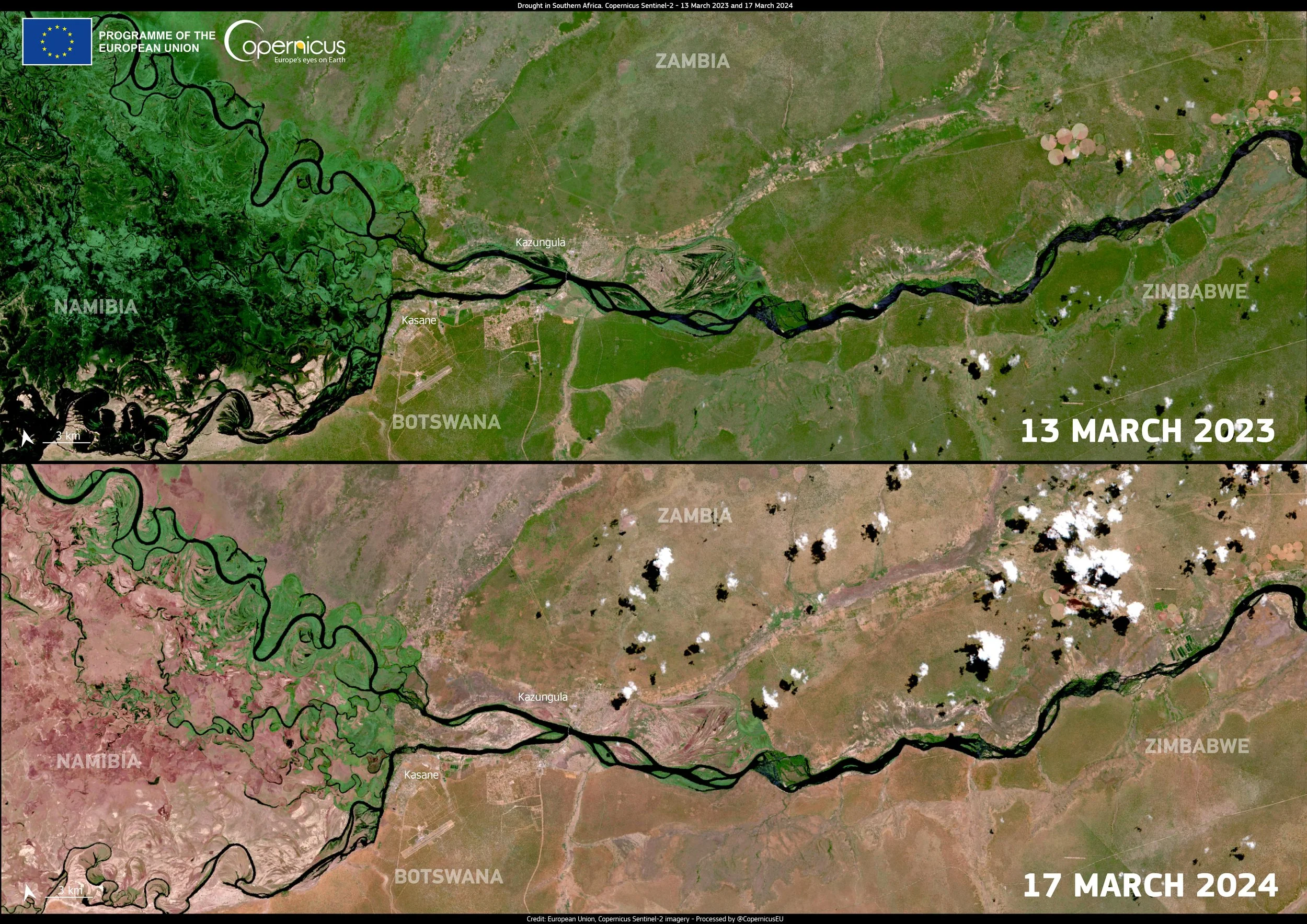
These Copernicus Sentinel-2 images, acquired in March 2023 (top) and 2024 (bottom), show the changes caused by drought along the borders of Zambia, Botswana, Namibia and Zimbabwe.

Specialised investment firms are launching adaptation funds. More than 3,200 climate-adaptation startups are now operating across Europe, with hubs in London, San Francisco, Singapore, and Berlin.

Yes, some political leaders are retreating from climate commitments, as the Japan Times put it in their year-end review: "In 2025, climate policy was shoved aside even as extreme weather intensified." Yes, the transition will be messy, bumpy, and painful. But companies are discovering that climate resilience isn't a cost centre, it's becoming essential for survival. We don't need every world leader on board. We need enough businesses, investors, and communities to recognise that adapting to a heating planet isn't defeatism. It's pragmatism. And it's where the opportunities of the next decade will be found.

This is why I have decided to pivot my career again. I see a future where resilience becomes the foundation of economic value, where the companies that thrive are the ones that learn to bend rather than break.

That's the future I want to help build. Through my work as a speaker, strategist, and storyteller, I aim to help leaders build future-ready systems that protect people, profit, and the planet.

What's Coming In January 2026

Early in January 2026, I plan to share my thinking on the Resilience Economy in a more direct way, going deeper into emerging markets, breakthrough technologies, and the strategic shifts that will define the next decade of business.

In the first edition, I'll outline the five key themes for 2026 in the Resilience Economy. These relate to where I see the most significant opportunities for leaders who want to move early.

If you're a leader who suspects that business-as-usual has an expiry date, who wants to understand not just the risks ahead but the opportunities they contain, I'd love to have you along for the journey.

For a glimpse into the types of ideas I have for the resilience economy, I’ve just had an article published in Capital Insights - Disruption 2035 (page 135) where I write about we could increase our chances of avoiding wars by investing in food, energy and water security, and why we need a new model for the defence industry by 2035, “Governments spend trillions globally on defence, often viewing it as a necessary evil. But this spending can be redefined. Why must ‘defence’ equal bullets, bunkers, and battleships? The true defence of a nation in 2035 lies in a stable water supply, a resilient food chain, and an independent energy grid.”

The Number That Should Change Your Strategy

$4.4 trillion. Every year. That's the gap between where climate finance is today and where it needs to be by 2030. Someone will fill it. Someone will build the systems, deploy capital, and capture returns.

The only question is whether your organisation will be among them, or whether you'll still be building for a world that no longer exists.

Zooming Out: From Digital Health to the Health of the Planet

Last year was a year of turbulent transition for me, both personally and professionally. It was a year in which I adapted to a new reality after my father had died (and I began to realise just how much he had meant to me), as well as adapting to my shift from in my working life, from looking at the future of Digital Health to looking at the future of Planetary Health. In this post, I’m going to write about the latter.

In terms of writing, I intend to return to blogging. I’m not sure why I lapsed years ago, when it comes to writing regular blog posts. It may have been because I was finding X (formerly known as Twitter) to be a useful way of sharing my ideas and engaging with others, and I even lapsed on tweeting regularly last year, so I intend to get back on there, in terms of sharing my ideas about the future. Finally, in this era where so much written content seems to be AI generated and often sounding increasingly generic, I felt like writing blog posts as a human being (without relying on any AI tools) might help my voice to stand out in this AI era of content creation.

It’s been almost 13 years since I left the security of my career and jumped into the unknown by setting myself up as a Digital Health Futurist (you can read more about that transition in my first blog post that I wrote back in 2013). That part of my career has been so rewarding, helping leaders across healthcare think differently about the future, and enabling them to take steps towards understanding what trends in digital health means for their own organisations, as well as for the patients they serve. Now something began troubling me in 2023, as I looked at the quest to digitise every aspect of healthcare, to collect, share and analyse as much health data from our lives as possible, to use AI to predict, prevent and prioritise, all over healthcare and the pharmaceutical industry. I came across this paper, on “The Environmental Impacts of Digital Health” and here is what made me stop and think;

“However, the global environmental implications of digital health have been overlooked. This commentary draws attention to the environmental impacts of digital health devices and communication networks, as well as the data produced by digital health activities. Unless serious attention is paid to greening digital health practices, the rise of digital health will significantly contribute to environmental change, and thus create outcomes of ill-health.”

Then I realised back in 2023, this wasn’t being discussed at digital health events, it wasn’t part of the conversation when people were talking about innovation in healthcare and pushing boundaries. A year after the launch of ChatGPT, many were excited about the potential for tools like this to make a huge impact in healthcare, yet hardly anyone seemed to be questioning the impact on the planet from these resource hungry technologies, in terms of increased emissions & energy/water usage. So then I got thinking, if this is missing from the conversation, how do I use my voice to get more leaders thinking about the future, from a wider perspective?

Sustainable healthcare isn’t a novel concept though. Here in the UK, NHS England was the first health system in the world to commit to Net Zero emissions. Then you have organisations like the Centre for Sustainable Healthcare that have been at the frontiers since 2008. Despite this noble work, there is still a lot that we need to understand. Consider this working paper published in March 2024, by the UK Energy Research Centre asking “What is the carbon footprint of digital healthcare?” and they summarise the situation as;

”The analysis reveals that while digital healthcare technologies (DHTs) offer avenues for reducing emissions—such as telehealth reducing the need for patient and clinician travel—they also entail significant environmental costs through the manufacturing and operation of digital infrastructure. The study underscores the necessity of developing an open and shared database of carbon factors for healthcare systems, standardising methodologies for calculating carbon impact, and undertaking both pre-implementation estimations and post-implementation realisations to better manage DHTs’ carbon footprint.”

So we just have to work towards decarbonising healthcare (and every other sector) and we have a chance of mitigating climate change by reducing our emissions from human activities, right? So I just needed to pivot to looking at the future of sustainable healthcare in my work. Actually, not quite.

The way I see it, sustainability is simply about minimising the harm from human activities, where we need to move to a regenerative future, where our activities as humans regenerate nature. Furthermore, the impact from how we live, work and play, on human health (and our every day lives) is much broader than simply more extreme weather due to climate change. This led me to discovering the relatively new discipline of Planetary Health, which a decade ago, The Rockefeller Foundation–Lancet Commission on planetary health, stated “The concept of planetary health is based on the understanding that human health and human civilisation depend on flourishing natural systems and the wise stewardship of those natural systems. However, natural systems are being degraded to an extent unprecedented in human history.”

Essentially, our health is linked to the health of the planet.

Then I came across the concept of the 9 planetary boundaries (climate change is just one of them), which illustrates the complex interconnections when it comes to Planet Earth, and the impact on everything that lives on the planet, including humans, and that we need to step back from the narrow lens through which we view the future, to be able to zoom out and understand the bigger picture. Scientists who have quantified these boundaries have shown that we have transgressed 6 of these 9 boundaries, and we need to respect all 9 planetary boundaries, not just for humanity today, but for those yet future generations yet to be born.

The 2023 update to the Planetary boundaries. Licensed under CC BY-NC-ND 3.0. Credit: "Azote for Stockholm Resilience Centre, based on analysis in Richardson et al 2023"

Everything I read about Planetary Health really broadened my thinking, above and beyond simply switching my focus to the decarbonisation of healthcare and making it more sustainable. So in October 2023, I made the decision to move from working as a Digital Health Futurist to a Planetary Health Futurist. So 2024 was about repositioning myself when it comes to my work, about learning from others, and about seeing problems (and the resulting opportunities) through the lens of Planetary Health. Throughout my career (even when I had jobs), I used to spot signals quite early on and would act upon those signals, in terms of taking a risk and trying something new. I must say that after making the switch, I still had a few doubts about this new chapter of my career, in terms of, are organisations I work with, ready to listen to keynote speeches about planetary boundaries and regenerative business models? However, about a year after I made this switch, Stanford University launched a Center for Human and Planetary Health. So momentum in the field is building. When I look at some of the pioneers who have been researching and advocating for Planetary Health for a long time already, one of those is Sam Myers, who was one of the founders of the Planetary Health Alliance back in 2015, and he now leads the Johns Hopkins Institute for Planetary Health, that was launched in April 2024.

My own quest in 2024 to build new connections, exchange ideas and to understand as much as possible in Planetary Health, led me to the Planetary Health Summit in April 2024, held at Sunway University in Kuala Lumpur, Malaysia.

The first thing that blew me away when was Professor Jemilla Mahmood, Executive Director of the Sunway Centre for Planetary Health, spoke at the launch of the meeting, and mentioned the cost of when countries start wars (given we have ongoing conflicts around the globe), in terms of having not just an impact on human lives, but on the health of the planet, given how carbon intensive military operations can be. I looked into this a bit further, and estimates are that militaries around the globe are responsible for 5.5% of greenhouse gas emissions (and we need to be reducing GHG emissions to combat climate change, amongst other things) To put this into context, if all the world’s militaries were a country, they would be the 4th biggest emitter in the world! Now we have an additional reason for working towards a peaceful, stable and secure world.

The next insight was hearing stories of loss from people that I normally wouldn’t meet, especially since most of my work in digital health has taken me to events in North America and Western Europe. Before Professor Mahmood’s speech, I was chatting to two young women from the Philippines sitting next to me in the hall. They had told me how their hometowns had been impacted by Typhoon Haiyan back in 2013 (one of the worst to ever hit the Philippines) and claimed over 6,300 lives. So during Professor Mahmood’s speech, when she urged us that we need from simply talking to action when it comes to safeguarding the health of the planet (and those that live on it, humans included), the two young women had tears in their eyes, as they were so moved by the call to action, when a lot of the time, they have felt like nobody was doing much around the world to reduce the chances of even more extreme weather events in the future. Witnessing these raw emotions motivated me to double down on my efforts in Planetary Health upon my return to the UK.

The third insight was in a session entitled, “Beyond Growth and GDP: From Profit to Wellbeing” and before this event, I had been caught in the trap of believing, all we need to do is to make everything we do, sustainable, e.g. switching from a petrol/diesel car to an electric vehicle, or reducing meat consumption, or decarbonising heavy industries. That’s where the talk by Dr Dave Webb who argued that “sustainability in business isn’t enough, and that we need to move to regenerative business, rather than simply minimising negative impact” – Kate Raworth was speaking in another session on Regenerative Economics, where she illustrated the regenerative vision in manufacturing, with factories as forests. These two talks completely moved the needle I wanted to have with people in the future, urging them to think beyond sustainability.

The fourth insight was from Dr Britt Wray introducing us to the concepts of eco-anxiety and ecological grief and there is so much to consider when it comes to supporting people who are advocating for transformative change. I was alarmed when talking to people in coffee breaks, that some people who have been fighting for a long time for in various aspects of Planetary Health and for taking on corporations, governments and other powerful entities have faced threats of violence and even death, simply because they are giving “nature” a voice in society, when nature is typically screaming with pain, and decision makers are deaf to those screams.

The final insight was the magical conversations with young people, from countries that usually have little representation at the events I’ve been to in the past. People like Dr Hashim Hounkpatin from Benin, and Maison Ole Kipila who is from a Masai tribe in Kenya. Speaking to each of them and hearing the stories of how their communities (especially in rural areas) have been impacted by human activities was a wake up call. However, I’m encouraged by their sense of wanting justice for their communities, and having the courage to want to fight for a better future, for a livable planet for everyone, no matter where they live. This left me wanting to reframe my own perspective in my own work to think broader. I read that by 2050, one in four people on this planet will be African.

Dinner with Dr Hashim, Maison and others I met from the Planetary Health Summit

My work revolves around telling stories about the future to decision makers. So how could I weave the insights and novel ideas I’ve been learning about in Planetary Health into the stories I tell when I am on stage? A wise friend in San Francisco urged me to bring my existing audience along with me in this chapter of my career, in terms of audiences from across healthcare. Find a way to connect the dots and bring people with you, he reminded me.

I got my first chance last summer at the Radical Health Festival in Helsinki, Finland. My closing keynote was on “Planetary Health: If nature had a voice, what would it demand from health systems?” and not only did I learn a lot whilst doing my research to prepare for the keynote, but the feedback I got from the audience afterwards was really positive too, and all those doubts about whether jumping from digital health to planetary health disappeared.

Broadening my outlook has made me realise that what happens around the globe can impact not just the planet, but what happens far away, could impact us, wherever we live, in terms of rising levels of pollution, emissions, and more. Take India for example, with a population of 1.4 billion, and an ambitious plan to grow the economy in such a way, that they can become a developed nation by 2047 (100 years since independence from the British) - a vision known as Viksit Bharat. The question I have is how does India achieve this, in harmony with nature, and not follow the extractive, destructive and polluting practices that “developed” countries today have followed in their quest to develop? It’s encouraging to hear the Indian economist, Shamika Ravi, remark, "We must grow in a way in which the world, the earth at large, is not affected adversely. And therefore, we aspire to have growth, which is more, not just equitable, but also sustainable.”

For example, one of the key pillars of this transition to Net Zero is the energy transition, away from fossil fuels to renewable and low carbon energy sources. It’s what led me to attend the FT Energy Transition Summit that was the first time the FT has run this event in India, a few months ago. How quickly India can make this transition impacts not just lives in India, but around the globe. Whilst I was in India, I hosted my own keynote session in Mumbai, “A New Era of Human Existence: Longevity and Planetary Health” looking at trends in people living longer in India but the impact of this on everything, from healthcare to the environment, in terms of resources consumed. I read a stat predicting that between 2000-2050, the fastest growing demographic in India, will be the 80+ group, set to grow by 700% during that time period. In a visit to Delhi, I got to experience just how hazardous the air quality was late last year when a number of factors led to air quality so bad, I needed to wear a N95 mask just to be able to breathe without any issues, whilst walking outdoors. I’ve got some more thoughts about India and Planetary Health will I’ll share in my next blog post.

So back to healthcare audiences, and one of the most exciting applications of AI tools is going to be in healthcare, not just in how a patient gets diagnosed or treated, but behind the scenes in a hospital lab, or in clinical trials and how new drugs come to market. However, if we deploy and scale AI tools (which are increasingly resource hungry) the way many are planning, we face the risk of worsening human health by worsening planetary health. At the UCLA Biomedical AI symposium last month, I delivered a deep dive on “Beyond Bias: Envisioning a Sustainable and Equitable Future for AI in Biomedicine” and looking at approaches to AI in healthcare that would help to mitigate bias and reduce the carbon footprint of those AI solutions, at the same time. I highlighted during my session to leaders from across Los Angeles, the urgent need to look at new AI solutions through the lens of Planetary Health, as not doing so could take us even further out when it comes to transgressions of planetary boundaries, including climate change. Then just a short while after I’ve been talking about that, Los Angeles has experienced the terrible wildfires. A powerful reminder of the need to act now.

Tomorrow, the eyes of the world will be on the United States, where President Trump will be returning for his second term in office. There is fear that based upon what’s he has said so far, new policies on oil and gas, could well undermine progress that the United States has made until now, but could also send a signal to other nations, that short term individualistic priorities are more important considering the needs of the planet, the 8 billion humans that live on it, and those that are yet to be born. We shall have to see what happens tomorrow.

There are people in the United States who care deeply about Planetary Health though, and they will be making their voices heard loud and clear in Washington, DC this year, regardless of what gets announced tomorrow. I’m talking about the convention in March 2025 called “Our Planet, Our Health” and a host of organisations are collaborating to host the largest event on planetary health/climate and health to date. One thing has become even clearer to me during 2024, and if we want to have a chance of a more hopeful future, we have to come together and make our voices heard, and be agents of change, for the change that we dream of.

I want to close this blog post on a positive note when it comes to the future. I came across something called the Regenerative Architecture Index, which “benchmarks practices’ progress in the move towards regenerative practice and projects. It recognises the need for a built environment that isn’t merely reducing its negative impacts, but has positive impacts for today and the long term.” It’s amazing that more and more people are thinking beyond sustainability and about a regenerative world. Oh wait, it gets better. Further down their website (see image below), look at the criteria they are using for the benchmarking.

Imagine if every leader on the planet considered the needs of 7 generations ahead when making decisions? Naturally, this has to be balanced alongside meeting the needs of those alive today, but this is the kind of new types of approaches I’m on the lookout for and wanting to share with you, as I continue my own journey exploring Planetary Health, and what these changing trends mean for leaders in any sector, not just in healthcare.

Which country might be the first to appoint a minister for Planetary Health in the next 5 years? I suspect given some countries are disproportionately impacted by transgressions of the 9 planetary boundaries, this kind of radical leadership is likely to come from a country in the Global South.

For 2025, one of my core themes of research will be looking at how we restructure how we live, work and play, to have this better future. This transition to a better future for all won’t be linear, it won’t be easy, and it won’t be cheap, but it’s the right thing to do. Each of us should consider ourselves a Planetary Steward.

I also believe that this is about involving people across society in these conversations about the future. This isn’t about the state restricting all of your choices on a daily basis, or making you feel guilty or ashamed because of your behaviour. Yes, we do need to change how we behave in society (and shaming people into changing behaviour is not healthy!) but at the same time, it’s about employing systems thinking, as we have these large interconnected systems that need to be transformed to enable this transition to occur. Understanding people’s fears, concerns and hopes for the future is critical. It’s not a case of a few people at the top dictating how you can live your life or run your business. The transformation to a healthier future for the planet and every species on it, including humans, is a complex process that will intertwine the social, cultural, political and economic strands that make up our increasingly globalised world. It’s not just about the technology, it never was.

In addition, I’m also looking at how we enable this shift to a nature centred regenerative economy and how do we translate a lot of this research, frameworks and concepts into practical tools that can underpin this shift.

Whether it’s new business models, new types of governance or new definitions of growth, I’ll be sharing my insights, ideas and experiences with you and I look forward to learning from each of you too!

[Disclosure: I have no commercial ties to any of the individuals or organizations mentioned in this post. This post was written entirely by me with no assistance from any AI tools]